
A brochure is the one piece of print that gets to tell your whole story. A business card gives your name, a flyer gives one message — a brochure gives you room: what you do, what you offer, and why someone should choose you, all in a format they can hold, fold away, and read later. In a city where business still happens face to face, that is a useful thing to have in your hand.
Whether you are a real estate agency showing new launches, a clinic explaining its services, a restaurant with a new menu, or a company at an exhibition, a well-printed brochure does the talking when you are not there. This guide to brochure printing Dubai covers the three decisions that matter most — size, fold and paper — plus how to design one people actually read.
For the full service, see our Stationery and office printing in Dubai range, where brochure printing sits alongside business card printing, flyer and catalogue printing, stamps and vouchers.
Why a Brochure Still Works in Dubai
Dubai does business in person. Deals start at exhibitions, at property launches, in showrooms, and in meetings across the city. In all of those places, the moment you finish talking to someone, the natural next step is to hand them something to take away.
A brochure is that something. Unlike a website link that can be forgotten or a social media post that disappears in a feed, a printed brochure sits on a desk, in a bag, or on a reception counter — and it keeps working after you have left the room. Someone who was not ready to decide on the day can pick it up again a week later and still find your name, your services and your phone number.
Brochures also suit the way Dubai businesses sell. A property brochure can show a floor plan and a price range. A clinic brochure can explain services and timings. A restaurant brochure can show the menu. And a company brochure at an exhibition can carry the whole range — services, past work, and contact details — in one neat package.
A brochure also works alongside your other branding. A customer who has seen your shop sign, then your business card, then your brochure has met your brand three times — and each time it looked the same, your business looked more organised. Our guide to Business Card Printing in Dubai covers the card that pairs with it.
Brochure Sizes: Which One Fits Your Message?
Size is the first decision, and it is really a question about how much you need to say — and where the brochure will be read.
A4 — The Full Story
A4 is the largest common brochure size, and it suits businesses with a lot to say: a company profile, a property launch, a service catalogue in brief, or a medical or educational guide. An A4 brochure gives each page room to breathe — large images, clear headings, and space for detail without looking crowded. It suits reception counters, meeting rooms and exhibition stands, where people have time to sit and read.
A5 — The Handy Middle
A5 is half the size of A4, and it is the most versatile brochure size. It fits in a handbag, a briefcase or a brochure rack, and it is easy to hand out at events. An A5 brochure suits menus, service lists, price guides and short company introductions — enough room for the essentials, without the weight of a full A4 document.
DL — The Slim Rack Brochure
DL is a tall, slim size — a third of an A4 sheet — and it is made for brochure racks, hotel lobbies, reception desks and exhibition counters. A DL brochure suits a short message with a strong image: a tour, a promotion, a single service, or a simple introduction. It is light, cheap to print in volume, and easy for a visitor to pick up on the way past.
Square — The Stand-Out
A square brochure is less common, and that is exactly why it stands out. It suits creative businesses, designers, photographers, cafes and lifestyle brands — anyone whose brochure is also a design statement. A square format gives images room and makes the brochure feel different the moment it is picked up.
If you are unsure which size suits your message, start with what the brochure has to do. A single offer needs a DL; a full company story needs an A4; most businesses in between will find A5 does the job. Ask to see samples before you order — holding the sizes in your hand makes the choice much easier than reading about them.
Brochure Folds: Bi-Fold, Tri-Fold and More
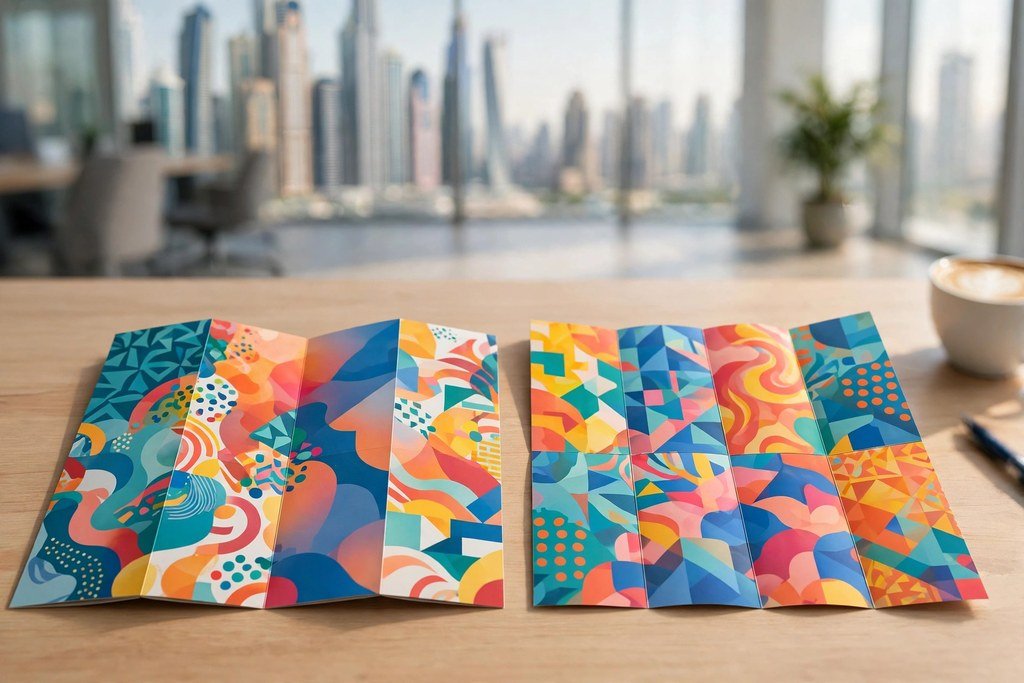
The fold is what turns a flat sheet into a brochure, and it decides how your reader meets your message — one panel at a time.
Bi-Fold — One Fold, Four Pages
A bi-fold is a single fold down the middle, giving you four panels: a front cover, two inside pages and a back cover. It is the simplest fold, and it suits a clear, unhurried message — a company introduction, a service overview, or a menu. The wide inside spread is good for a large image or a floor plan that needs room.
Tri-Fold — The Classic
A tri-fold divides the sheet into three panels, giving you six in total. It is the classic brochure fold, and it suits most businesses: the front panel is the cover, the inside three panels tell the story in order, and the back panel carries your contact details. A tri-fold brochure printing Dubai order is the safe choice when you are not sure which fold to pick — it is familiar, it fits in a rack, and readers know how to open it.
Z-Fold — The Unfolding Story
A Z-fold folds back and forth like the letter Z, so the brochure opens out in a zigzag. It suits a message that unfolds step by step — a process, a journey, a before-and-after, or a story with a clear order. Each panel reveals the next, which keeps the reader moving through it.
Gate Fold — The Reveal
A gate fold has two side panels that fold inwards and meet in the middle, like gates closing. Opening them reveals a wide inside spread — a good place for a big image, a property, a map, or a bold statement. A gate fold suits launches and premium brochures, where the opening itself is part of the experience.
Roll Fold — Four Panels In
A roll fold wraps the panels around each other, one inside the next, giving you eight panels from a single sheet. It suits longer messages that still need to fold down small — a detailed service guide, a product range, or a multi-step explanation.
Whichever fold you choose, keep one rule in mind: each panel should carry one idea. A panel that tries to say three things at once becomes hard to read — and a reader who has to work hard will stop reading.
Choosing the Right Paper for Your Brochure
Paper changes how a brochure feels, how it looks, and how long it lasts in someone’s hands. The choice is worth a few minutes of thought.
Standard Paper
A standard brochure paper is clean, smooth and practical. It prints sharply, it folds neatly, and it suits everyday use — brochures handed out in volume at exhibitions, events and receptions. If you are printing a large quantity for general distribution, standard paper is the sensible starting point.
Thick and Premium Paper
A thicker paper feels more substantial in the hand, and that weight alone signals quality. Thick paper suits premium brochures — a property launch, a luxury brand, a company profile for important clients — where the brochure itself is part of the impression. A thicker brochure also holds up better in a bag or on a counter, and it folds with a crisper edge.
Matte Paper
A matte paper gives the brochure a soft, non-reflective surface. It looks calm and professional, it is easy to read under bright lights, and it does not show fingerprints. Matte suits corporate brochures, professional services, clinics and consultancies — anywhere the message matters more than the shine.
Gloss Paper
A gloss paper gives the brochure a shine that makes colours look richer and photographs look brighter. It suits brochures where images do the selling — property, food, travel, retail and events — and it adds a thin protective layer against scuffs and marks.
Recycled Paper
Recycled paper has a natural, slightly off-white look and a softer feel. It suits businesses that want their brand to read as honest and environmentally aware, and it pairs well with a simple, clean design and natural colours.
If you are unsure which paper suits your brand, ask to see samples before you order. The feel of the paper is as much a part of the brochure as the design on it.
Designing a Brochure People Actually Read
A brochure gives you more room than a card or a flyer — but that room is a temptation. The best brochures are the ones that respect the reader’s time.
- Start with the cover. The cover is the only panel most people will see first. Give it one strong image, your business name, and a short line that says what you do. If the cover does not earn a second look, the inside pages will never be read.
- One idea per panel. Each panel of a brochure should carry a single idea — one service, one benefit, one offer. A panel crowded with text gets skipped; a panel with a clear heading and a short paragraph gets read.
- Lead with benefits, not features. Readers care about what your service does for them, not how it works. Say what the customer gets first, then explain how.
- Use your brand colours and logo consistently. A brochure should look like it belongs to your business — the same logo, the same colours, the same style as your business card, your signage and your website. That consistency is what makes a brand recognisable.
- Make contact easy. Your phone number, website and location should be easy to find — on the back panel, at least, and ideally on the cover too. A reader who has to hunt for your number will not bother.
- Use real images where you can. A photograph of your actual work, your team or your premises tells a truer story than a generic stock image. If you use your own photos, make sure they are high quality — a blurry photo in a printed brochure stands out for the wrong reasons.
- Check everything twice. A brochure with a wrong phone number, a spelling mistake or an old price is worse than no brochure at all. Check every digit and every word before you approve the print, and ask someone else to check it too.
- Ask for a digital proof. Request a digital proof before approving production, so you can check the layout, the folds, the spelling and the logo placement first.
A brochure that matches the rest of your stationery works harder than one that stands alone. Cards, letterheads and brochures that share the same logo and colours make your whole business look consistent — from the first meeting to the final invoice.
Brochure, Flyer or Catalogue — Which Do You Need?
Brochures, flyers and catalogues are often confused, and choosing the wrong one wastes money and misses the reader. The difference is simple: it is about how much you need to say, and how long the reader should keep it.
A flyer is a single sheet, usually one message: an offer, an event, an opening, a promotion. It is cheap, fast to hand out, and meant to be read once and acted on quickly. Flyer printing Dubai suits short campaigns and announcements — if your message fits in a few lines, a flyer is enough.
A brochure is a folded sheet with several panels, and it tells a fuller story: who you are, what you offer, and why someone should choose you. It is meant to be kept, read properly, and referred back to. If your message needs more than a headline, a brochure is the right format.
A catalogue is a longer document — many pages, many products or services, with prices, pictures and details. Catalogue printing Dubai suits businesses with a full range to show: a product list, a price list, or a complete service menu. A catalogue is a reference document; a brochure is an introduction.
Many businesses need more than one. A flyer brings people in, a brochure explains the business, and a catalogue lists everything in detail. If you are not sure which you need, start with the brochure — it is the most versatile of the three — and add the others as your range grows. Our Business Card Printing in Dubai guide covers the card that completes the set.
Where Brochures Work Best in Dubai
A brochure works anywhere people have a moment to read — and Dubai gives it plenty of those moments.
At exhibitions and trade shows. A brochure is the classic exhibition handout. Visitors collect them, compare them later, and keep the ones that stand out. A clear brochure with a strong cover is the one that survives the journey home in the bag.
On reception counters and in waiting areas. A brochure on a reception counter is read while people wait — in a clinic, a showroom, a salon or an office. It is quiet selling, done while your customer is already with you.
In property sales and launches. A property brochure carries floor plans, images and the details a buyer needs to decide. It is the document a buyer takes home, shows to family, and reads again before calling back.
In welcome packs and gift bags. A brochure pairs naturally with branded gifts in a welcome pack — the gift is remembered, and the brochure explains what the business does. See our Corporate Gift Items Dubai range for items that pair with a brochure at events and launches.
In direct handouts and door drops. A DL brochure fits a brochure rack, a hotel lobby and a letterbox. For local businesses — restaurants, clinics, gyms, services — a well-designed brochure in the right area still brings people through the door.
How Ordering Works
Ordering brochures from Iconify Advertising is straightforward:
- Tell us what you need — the size and fold you prefer, the paper, your design or logo, and roughly how many brochures you need.
- We help with the design — our team prepares artwork that fits the size and fold, including the layout, the images, and the contact details on the right panels.
- We print and finish it — your brochures are printed, folded and cut ready to use.
For pricing for your exact requirements, contact us for a quote. See our Stationery and office printing in Dubai page for the full range.
Frequently Asked Questions
What is the best size for a brochure?
It depends on how much you need to say. A4 suits a full company story or a property launch. A5 is the most versatile size for menus, service lists and introductions. DL suits a short message in a brochure rack. Square suits creative brands that want to stand out.
What is the difference between a bi-fold and a tri-fold brochure?
A bi-fold has one fold and four panels — a front cover, two inside pages and a back cover. A tri-fold has two folds and six panels, with the story told in order across the inside. Tri-fold is the classic choice; bi-fold suits a simpler message with a wide inside spread.
What paper should I choose for my brochure?
Standard paper suits everyday use in larger quantities. Thick paper feels more premium and suits launches and important clients. Matte paper looks calm and professional and is easy to read; gloss paper makes colours and photographs look richer. Recycled paper suits brands that want a natural look.
Should my brochure match my business card?
Yes, if you can. A brochure, a business card and your other stationery that share the same logo and colours make your business look consistent and professional. Our stationery range covers all of these, so a matching set can be printed together.
What is the difference between a brochure, a flyer and a catalogue?
A flyer is a single sheet with one message, meant to be read once. A brochure is a folded sheet that tells a fuller story and is meant to be kept. A catalogue is a longer document that lists a full range of products or services in detail.
How much does brochure printing cost in Dubai?
The cost of brochure printing Dubai depends on the size, the fold, the paper, the design, and the quantity. Contact us for a quote with your requirements and we will give you a price for your exact order.
Get Your Brochures Printed in Dubai
The right size, the right fold, and the right paper turn a simple brochure into a story your customer keeps — and a reminder of your business that works long after you have handed it over.
Iconify Advertising — based in Hor Al Anz, Deira, Dubai. Call +971 50 542 4870 or contact us for a quote.