
A business card is small, but it does a job no screen can do. You hand it to someone at a meeting, at an exhibition, or over coffee, and it stays in their pocket, their wallet, or on their desk long after the conversation ends. In a city where business runs on face-to-face meetings, a well-printed card is still one of the simplest ways to be remembered.
Why a Business Card Still Matters in Dubai
Dubai does business in person. Deals start at exhibitions, at networking events, at property launches, and in meetings across the city. In all of those places, the moment you meet someone new, the natural next step is to exchange cards.
A phone number typed into a phone is easy to lose among hundreds of contacts. A card is different. It carries your name, your company, and your logo in a form the other person can see, hold, and find again.
That is why business cards are not only for big companies. Start-ups, freelancers, consultants, real estate agents, salon owners, and small trading businesses across Dubai and the UAE all use them — because a card costs little, travels everywhere, and works every time you meet someone new.
If you are looking for business card printing Dubai, this guide explains how to choose the right paper and finish, what to put on the card, and how to design one that people keep. For the full service, see our Stationery and office printing in Dubai range, where business cards sit alongside brochures, flyers, catalogues, stamps and vouchers.
Choosing the Right Paper for Your Business Card
Standard Paper
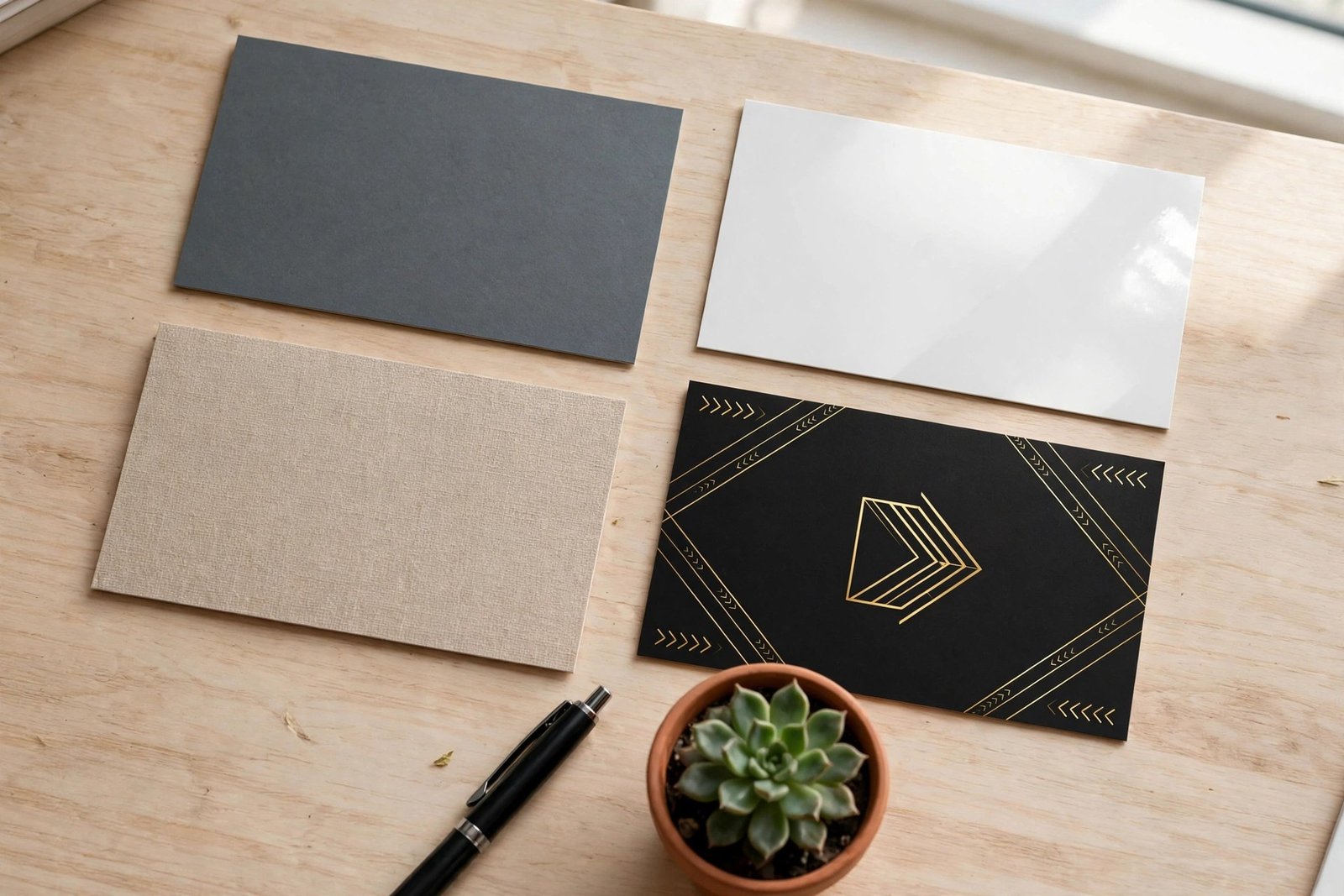
A standard business card paper is clean, smooth, and practical. It prints sharply, it is easy to write on, and it suits everyday business use — cards you hand out in volume at exhibitions, conferences, and networking events.
Thick and Premium Paper
A thicker card feels more substantial in the hand. When someone receives a thick card, the weight alone signals quality. Thick paper suits senior roles, luxury brands, and businesses where the card itself is part of the impression — property, finance, hospitality, and professional services. A thicker card also holds up better in a wallet or a cardholder.
Textured Paper
Textured paper has a surface you can feel — a fine linen or laid finish that gives the card a distinctive touch. It suits creative businesses, designers, and brands that want their card to feel different the moment it is picked up. Textured paper works best with simple, bold designs, because fine detail can get lost in the texture.
Recycled Paper
Recycled paper has a natural, slightly off-white look and a softer feel. It suits businesses that want their brand to read as honest and environmentally aware, and it pairs well with a simple, clean design.
If you are unsure which paper suits your brand, ask to see samples before you order. Holding the options in your hand makes the choice much easier than reading about them.
Business Card Finishes: Matte, Gloss, Foil and More
The finish is what turns a printed card into a finished card. It changes how the card looks, how it feels, and how it handles everyday use.
Matte Lamination
A matte finish gives the card a smooth, soft, non-reflective surface. It looks calm and professional, it does not show fingerprints, and it is easy to read under bright office lights. Matte suits most business cards, especially for corporate, legal, consulting, and professional services.
Gloss Lamination
A gloss finish gives the card a shine that makes colours look richer and photographs look brighter. It suits cards with bold colours, images, or a vibrant brand identity, and it adds a thin protective layer against scuffs.
Foil Stamping
Foil adds a metallic accent — usually gold, silver, or copper — to a logo, a name, or a border. It catches the light and gives the card a premium feel. Foil suits luxury brands, hotels, jewellers, and any business where a touch of shine fits the brand. It works best when used sparingly: a foil logo on a clean card stands out far more than foil everywhere.
Embossing and Debossing
Embossing raises part of the design above the surface of the card, and debossing presses it in. Both give the card a texture you can feel with your fingers. A raised or pressed logo adds a quiet, expensive feel, and it suits brands that want their card to be remembered by touch as well as by sight.
Spot UV
Spot UV adds a glossy, raised coating to selected parts of the card — a logo, a pattern, or a line of text — while the rest of the card stays matte. The contrast between the shiny detail and the soft background makes the design stand out.
Rounded Corners
Rounded corners are a small detail that changes the feel of a card. They stop the corners from bending and fraying in a wallet, and they give the card a softer, more modern look. They suit creative and lifestyle brands.
Single-Sided or Double-Sided?
A single-sided card keeps everything on one side: your name, role, company, phone, email, and website. It is clean, classic, and easy to read, and it suits most businesses. The blank back also leaves room for a handwritten note — a useful touch when you meet someone and want to add a reminder.
A double-sided card gives you more room. The front can carry your name and logo, and the back can carry your services, a tagline, a QR code, or a second language. In Dubai, where many businesses serve both English-speaking and Arabic-speaking clients, the back of the card is a natural place for an Arabic version of your details.
Design Tips for a Business Card People Keep
A business card is small, so every design decision shows. A few simple rules will keep your card clean and easy to use.
- Keep it simple. A card has room for a name, a role, a company, and a few contact details. Do not try to fit your whole business onto it. The card’s job is to make it easy to contact you.
- Make your name easy to read. Your name is the most important thing on the card. Use a clear, readable typeface, and make it large enough to read at arm’s length.
- Use your brand colours. A card should look like it belongs to your business. Use your logo and your brand colours, and keep them consistent with your other stationery, your signage, and your website.
- Leave space around the edges. Text and logos that run close to the edge of the card look cramped and can get cut during printing. Keep a clear margin around everything.
- Check your contact details twice. A card with a wrong phone number or email address is worse than no card at all. Check every digit and every letter before you approve the print, and ask someone else to check it too.
- Use the back with purpose. If you print on both sides, give the back a job — a second language, a QR code to your website, or a short list of services.
- Ask for a digital proof. Request a digital proof before approving production, so you can check the layout, spelling, and logo placement first.
A good card also works hard in the places where Dubai does business. At an exhibition, a clean card with a clear name and phone number is the one that gets kept. At a meeting, a thick card with a foil logo is the one that gets noticed. And at a launch or a networking event, a card that matches your other branded items — your brochures, your gift items, your stand — makes your whole business look organised. See our Corporate Gift Items Dubai range for branded items that pair naturally with a new set of cards.
Match Your Card to the Rest of Your Stationery
A business card rarely works alone. It sits alongside your letterhead, your envelopes, your brochures, and your flyers — and when they all share the same logo, colours, and style, your business looks consistent everywhere.
If you are printing new cards, it is worth looking at the rest of your stationery at the same time. A matching set gives every document the same professional look, from the first meeting to the final invoice. Our stationery range covers business card printing, brochure printing, flyer and catalogue printing, stamps and vouchers, all printed for businesses across Dubai and the UAE.
Stickers are another useful partner for a new card. A branded sticker on a gift bag, a product box, or a welcome pack carries the same logo as your card. Read our guide to Sticker Printing in Dubai for the types and materials available.
How Ordering Works
Ordering business cards from Iconify Advertising is straightforward:
- Tell us what you need — the paper and finish you prefer, the design or logo, whether you want single-sided or double-sided printing, and roughly how many cards you need.
- We help with the design — our team prepares artwork that fits the card, including the layout, the logo placement, and the contact details.
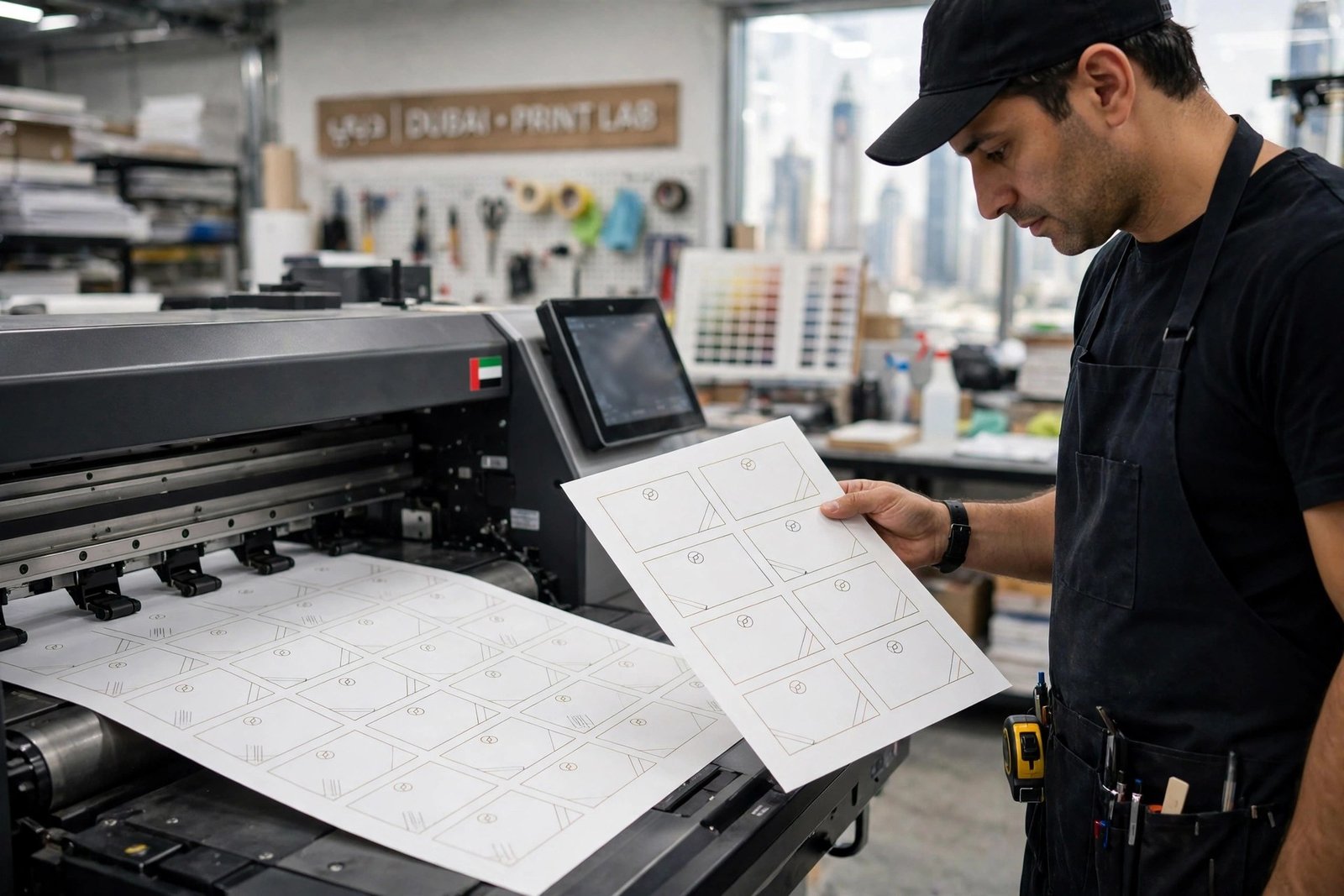
- We print and finish it — your cards are printed, laminated or foiled as chosen, and cut ready to use.
For pricing for your exact requirements, contact us for a quote.
Frequently Asked Questions
What paper should I choose for my business cards?
It depends on the impression you want. Standard paper suits everyday use and larger quantities. Thick paper feels more premium and suits senior roles and luxury brands. Textured paper suits creative businesses, and recycled paper suits brands that want a natural look. Ask to see samples before you order.
What is the difference between matte and gloss lamination?
Matte lamination gives a soft, non-reflective surface that looks calm and professional and does not show fingerprints. Gloss lamination gives a shine that makes colours look richer and adds a protective layer against scuffs.
Can I have gold foil on my business card?
Yes — foil stamping adds a metallic gold, silver or copper accent to a logo, name or border. It suits luxury brands and premium cards, and it works best when used sparingly on a clean design.
Can my business card be printed in Arabic and English?
Yes — a double-sided card is the natural way to do this, with one language on each side. The back of the card can also carry a QR code, a tagline, or a short list of services.
Should my business card match my other stationery?
Yes, if you can. Cards, letterheads, envelopes, brochures and flyers that share the same logo and colours make your business look consistent and professional. Our stationery range covers all of these, so a matching set can be printed together.
How much does business card printing cost in Dubai?
The cost of business card printing Dubai depends on the paper, the finish, the design, and the quantity. Contact us for a quote with your requirements and we will give you a price for your exact order.
Get Your Business Cards Printed in Dubai
Iconify Advertising — based in Hor Al Anz, Deira, Dubai. Call +971 50 542 4870 or contact us for a quote.